






Enjoy your tea! A Guide to Tea Ware
Today we’ve decided to put together a brief guide to tea ware and explain, in simple, accessible language, what each item is used for and where to pour the tea. Let’s start by gradually working out what everything is called, how it’s used, and what it’s for. For someone discovering tea, the atmosphere is important. The fire, the boiling water, the beautiful crockery, the aromas, the conversation — all of this matters.
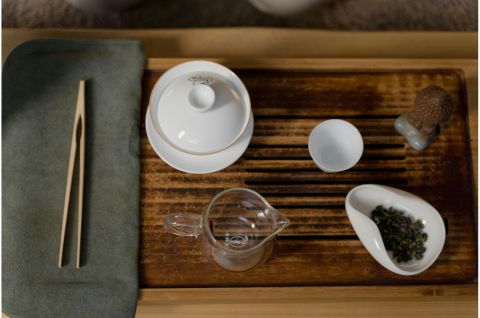
Gaiwan
What is it? Literally, this word translates from Chinese as ‘a bowl with a lid’.
It is a complete set, not just a vessel: it consists of a cup, a lid and a saucer. Brewing in a gaiwan is used when you need to taste the tea, for example, when buying it. In such cases, it is important to preserve the tea’s neutral flavour, as well as to be able to observe the leaves as they brew and appreciate their aroma. This brewing method is also suitable for everyday tea drinking: any tea can be brewed in a gaiwan, but it is particularly well-suited to lightly fermented (light) oolongs.
One of the most versatile options for a novice tea lover is a porcelain gaiwan. But why not a clay one, for example? The reason is that using a clay gaiwan to brew teas with varying degrees of fermentation can lead to a mixing of flavours, with the strong aromas of more robust teas (red, Pu Erh) overshadowing the delicate white, green and oolong teas.
On brewing tea in a gaiwan
- Bring the water to the boil or heat it to a temperature suitable for the chosen tea.
- Pour the boiling water into the gaiwan, wait until it has warmed up, then pour the water away.
- Add the tea leaves to the warmed gaiwan.
- Rinse the tea leaves and immediately pour the water away, thereby washing them.
- Pour water down the side of the teapot again to fill it two-thirds full and cover the teapot with the lid.
- Wait 15–20 seconds, then pour the tea into a chahai or into bowls.
- Serve the tea.
- Repeat steps 5, 6 and 7, gradually increasing the steeping time.
Chahu
This word translates very simply — essentially, it is the teapot we are familiar with. Teapots come in all sorts of shapes, designs and sizes, so you can always find one to suit your taste. It is worth noting that for a small group, a teapot with a capacity of 150–200 ml is quite sufficient if you are choosing it for a tea gathering with high-grade tea that can be brewed several times.
Chahai
The word ‘chahai’ translates as ‘Sea of Tea’, whilst ‘guandaobei’ (the Taiwanese name for this vessel) translates as ‘Bowl of Justice’. This is the name given to the vessel into which tea is poured from a teapot or gaiwan once it has been brewed to the desired consistency. Usually, a chahai is shaped like a small jug and resembles a cream or milk jug. It is most often made of ceramic, porcelain or glass. The size of the chahai is chosen so that it can hold the entire infusion from the teapot.
There are five reasons why tea from a teapot is not poured directly into cups.
- If tea is poured directly from the teapot into cups, bypassing the tea strainer, the infusion remaining in the teapot may become over-brewed by the time it is poured into the cups again, turning bitter and unfit for consumption. Therefore, the brewing process must be stopped by immediately pouring all the tea out of the teapot.
- If tea is poured directly into the cups, the aroma, taste and strength of the brew in them will vary slightly. In the first cups, the tea will be less strong and more aromatic, whilst in the last ones it will be stronger, with a more pronounced taste but a weaker aroma. By pouring the tea from the chahai, we can be sure that all participants in the tea ceremony are drinking an infusion with identical properties. This is precisely why the chahai is also called gundaobei — the ‘bowl of justice’.
- The chahai allows all participants in the tea ceremony to examine and appreciate the depth of colour of the tea infusion.
- By pouring the tea into a separate vessel, we lower its temperature slightly, so that once poured into the cups, the tea will not be so scalding and can be drunk immediately.
- Small tea leaves and tea dust that may have remained in the infusion do not end up in the cups, but settle in the chahai.
Chahe
This is a small box into which the tea is transferred before brewing (during the Gongfu tea ceremony) to show it to guests and introduce them to the tea — to warm the leaves with one’s breath and inhale the aroma as it unfolds for the first time.
Tea bowls
No tea party is complete without them, although in ancient times the Chinese could easily have managed without teacups or mugs—they drank tea straight from the spout of the teapot or from a gaiwan, which served as their cup, and pushed the floating tea leaves aside with the lid. Much tea has flowed since then, but even today it is customary to drink it from small vessels made of porcelain, glass or clay. Take a sniff of an empty bowl, catch the changing notes of the cooling aroma — and you will understand what we mean.
Tea strainer
The tea strainer catches the tea leaves on their way into your bowl. Its design varies greatly: from simple models to exquisite works of art. The strainer is most often made of stainless steel, glass or clay; eco-friendly options, such as those made from pumpkin, are less common.
Chaban
Translated, ‘chaban’ means ‘tea board’. It is a small table with a built-in tray for draining water. You can place all the necessary tea ceremony accessories on the chaban and conveniently warm the tea set with boiling water. It is a tea table, the foundation of the tea ceremony and a handy accessory for a regular, refined tea gathering. Depending on the tea utensils used, this table can be used for both a tea ceremony and a casual tea gathering for 2–6 people. Chaban come in a wide variety of sizes — from very small to large tables. They are most often made from hardwoods and bamboo. Occasionally, chaban made of stone, plastic or steel can be found.